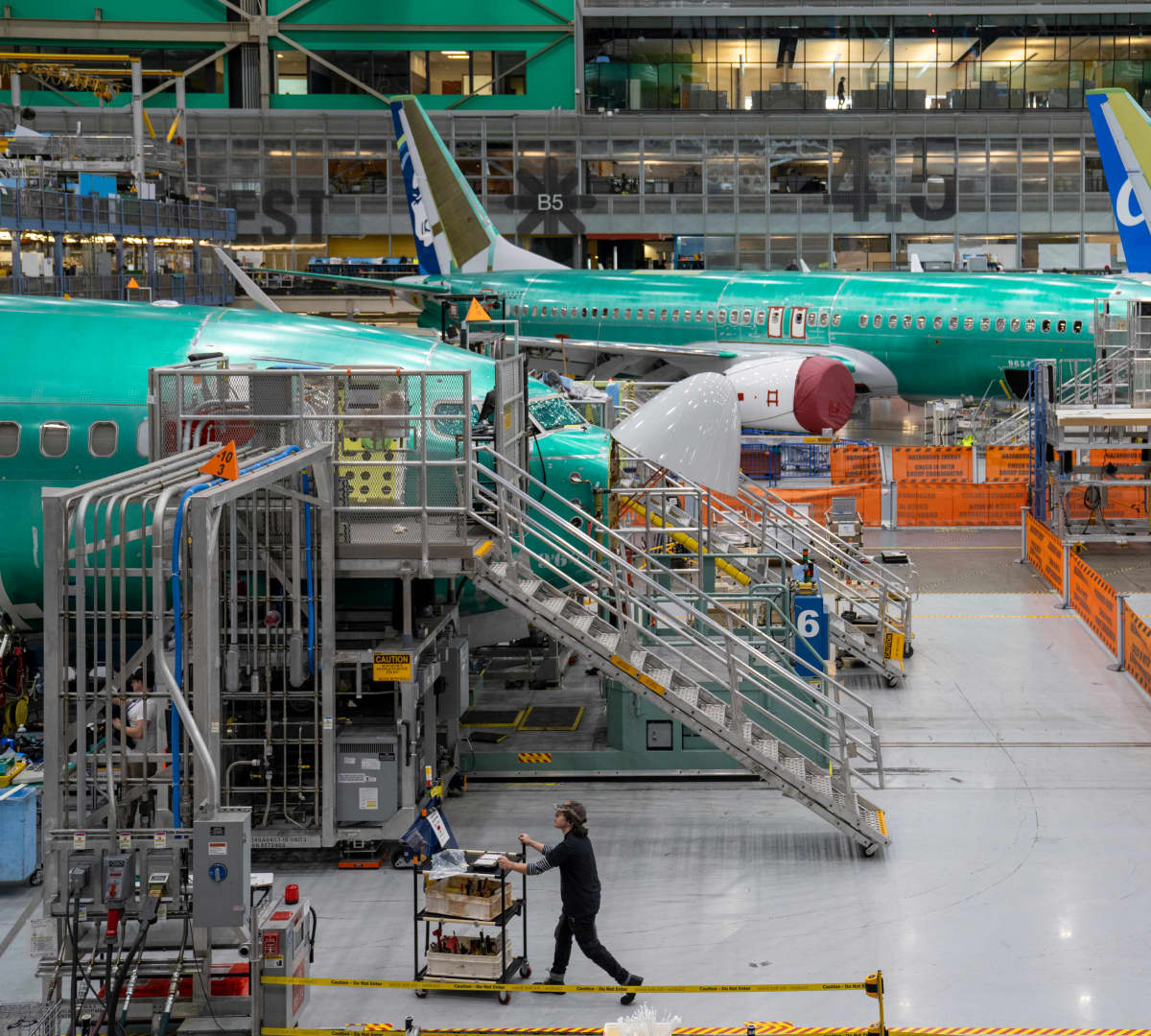
Boeing said Monday that it plans to cut 5% of its commercial airplane workforce because its production ramp-up is moving more slowly than the company expected. According to the report, the reductions will come through a combination of attrition and layoffs, and notifications begin in December. Stephanie Pope, head of the commercial aircraft unit, framed the decision in a memo to staff as a matter of alignment: the company is overstaffed for the output it now plans to produce.
That framing deserves scrutiny. Pope said the company is still working to stabilize production rates of its 737 Max planes, which are built outside Seattle. CEO Kelly Ortberg told investors last month that Boeing would not significantly increase Max output until the second half of next year, and he pointed to slower-than-expected wing production. The report also notes that Boeing has been trying to stabilize output at about 47 Max planes a month, while targeting 52 a month in the second half of 2027.
Those numbers suggest the workforce was sized for a schedule the company could not meet. When a manufacturer hires and plans around a production rate, then misses the rate for an extended period, the resulting idle capacity is a planning and supply-chain failure before it is a labor decision. Workers who were recruited, trained and retained to meet a ramp-up now face cuts because the ramp-up stalled. The report does not say how many roles fall under the 5% figure, so the scale of the affected workforce remains unclear from the available material.
Boeing should be more transparent about its assumptions. The company should explain which suppliers and bottlenecks, including wing production, are driving the delay, and how much of the reduction is attrition versus involuntary layoffs. Investors and suppliers deserve a clearer timeline for the 52-a-month target, since the gap between the current 47 and the planned 52 is the variable that determines whether these cuts are temporary or permanent. Affected workers and communities need advance notice that goes beyond a general memo.
Boeing's cuts may be the rational response to a slowed schedule, but they are also a warning. A production target that depends on fixing wing output and stabilizing rates should not be treated as settled staffing math. The company should prove the ramp-up before it reshapes its workforce around it.